Comparison
BREAKING: Retatrutide doubles semaglutide's weight loss head to head
In the first head-to-head trial, retatrutide cut weight 20.9% vs 9.4% on semaglutide. What that means, side effects, FDA timing and why research vials are risky.
By Julian Caraulani · Updated November 2, 2026
Yes, retatrutide beat semaglutide in the first trial to test them side by side. In TRANSCEND-T2D-2, adults with type 2 diabetes on the highest retatrutide dose lost 20.9% of their body weight over 80 weeks, against 9.4% on semaglutide (Ozempic): more than twice as much (AJMC, 28 Oct 2026). Retatrutide is not FDA-approved, and the research-peptide vials sold online are not the drug in this trial.
The short version (checked 2 November 2026)
- Head to head: 20.9% weight loss on the highest retatrutide dose vs 9.4% on semaglutide at 80 weeks, in 1,298 adults with type 2 diabetes. That is 2.2 times as much, or 11.5 percentage points more.
- Blood sugar: A1C fell 2.2 points on retatrutide vs 1.8 on semaglutide.
- Stopped because of side effects: 7.9% on the highest retatrutide dose vs 2.7% on semaglutide.
- Not approved: Lilly plans to file with FDA in the first quarter of 2027, so the earliest decision is likely the second half of 2027.
- Not compoundable: FDA says retatrutide cannot be used in compounding, and the October 2026 HHS peptide policy does not cover it.
Retatrutide is the most talked-about peptide of 2026. It is Eli Lilly's experimental weekly injection, a peptide drug like semaglutide and tirzepatide, and it is also the peptide most often sold illegally online as a research chemical. This site compares prescription peptide programs and normally leaves weight-loss drugs to others, but retatrutide sits at the center of this year's peptide news, so here is what the new trial shows, what it does not, and what to do with it.
What the new trial found
On 28 October 2026 Lilly announced topline results from TRANSCEND-T2D-2, the first phase 3 trial to put retatrutide against another approved drug. HCPLive summarizes the design: "The randomized, open-label trial (NCT06260722) enrolled 1,298 adults with type 2 diabetes" (HCPLive, 28 Oct 2026). People got one of two retatrutide doses or semaglutide sold as Ozempic, at the highest dose approved for type 2 diabetes, for 80 weeks.
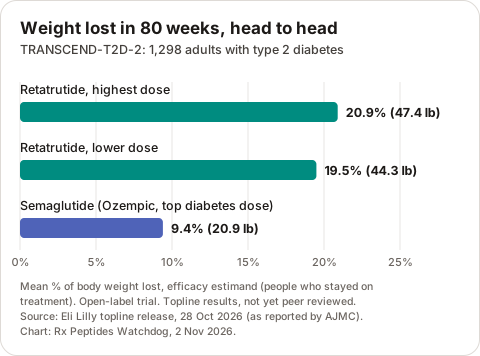
The full results at 80 weeks, from Lilly's release as reported by AJMC and HCPLive:
| At 80 weeks | Retatrutide, highest dose | Retatrutide, lower dose | Semaglutide (Ozempic) | Source |
|---|---|---|---|---|
| Weight lost | 20.9% (47.4 lb) | 19.5% (44.3 lb) | 9.4% (20.9 lb) | AJMC |
| A1C drop (points) | 2.2 | 2.2 | 1.8 | AJMC |
| Starting weight (average) | 225.8 lb, BMI 36.8 | same group | same group | AJMC |
AJMC's one-line summary: retatrutide produced "more than twice the weight loss of the highest approved dose of semaglutide for type 2 diabetes" (AJMC). Lilly also reported better cholesterol, triglyceride and blood pressure numbers on retatrutide, without saying by how much.
Three things to hold next to those numbers:
- It is a press release, not a paper. "Detailed results will be presented at a future medical meeting and published in a peer-reviewed journal" (AJMC). No outside reviewer has checked the data yet.
- It counts people who stayed on the drug. "All results reflect the efficacy estimand, which assumes participants remained on treatment for 80 weeks without starting additional glucose-lowering medication" (AJMC). Counting everyone who started, including those who quit, usually gives smaller numbers for every arm.
- The semaglutide arm was the diabetes dose. Ozempic's top diabetes dose is lower than Wegovy's top weight-loss dose (Wegovy label, DailyMed), and people with diabetes lose less weight on all of these drugs. So the result tells you most about people with type 2 diabetes. It is still the only head-to-head comparison of the two molecules so far.
How big is "over 50%" really?
The claim going around is that retatrutide beats semaglutide by more than 50%. On the numbers, that undersells it. Here is the math, in plain terms.
Relative difference asks how many times more weight one group lost. Absolute difference asks how many more percentage points of body weight. Both are honest; they just answer different questions.
| Comparison | Retatrutide | Semaglutide | Absolute gap | Relative gap | Type |
|---|---|---|---|---|---|
| TRANSCEND-T2D-2, highest dose | 20.9% | 9.4% | 11.5 points | 122% more (2.2 times) | Head to head |
| TRANSCEND-T2D-2, lower dose | 19.5% | 9.4% | 10.1 points | 107% more (2.1 times) | Head to head |
| TRIUMPH-1 vs STEP 1, obesity, no diabetes | 25.0% | 14.9% | 10.1 points | 68% more | Separate trials |
Sources: AJMC, TRIUMPH-1, NEJM 2026, STEP 1, NEJM 2021. Our arithmetic: 20.9 divided by 9.4 is 2.22.
So "over 50%" is true both ways, and the head-to-head trial says "more than double". In pounds, the average person on the highest retatrutide dose lost 47.4 lb, about 26 lb more than the 20.9 lb on semaglutide.
The third row is the comparison most weight-loss readers care about, people with obesity and no diabetes, and it comes from two different trials. TRIUMPH-1 enrolled 2,339 adults ("A total of 2339 participants underwent randomization") and its highest dose arm lost 25.0% at 80 weeks "versus -3.9% in the placebo group" (TRIUMPH-1, NEJM). Semaglutide's STEP 1 reported "-14.9% in the semaglutide group as compared with -2.4% with placebo" at 68 weeks (STEP 1, NEJM). Both figures count everyone randomized, which makes them fairer to line up, but different years, people and trial lengths still blur the gap.
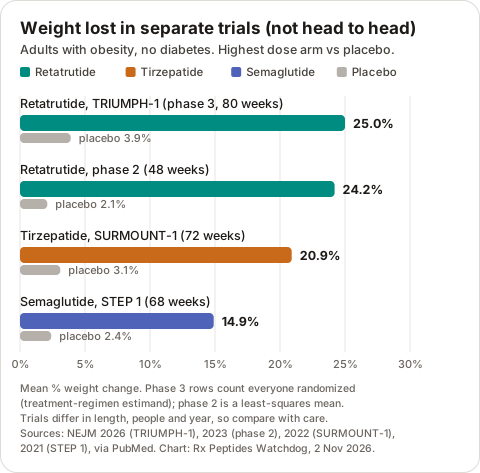
For scale, the one published head-to-head obesity trial among approved drugs, tirzepatide against semaglutide, found "-20.2% (95% confidence interval [CI], -21.4 to -19.1) with tirzepatide and -13.7% (95% CI, -14.9 to -12.6) with semaglutide" at 72 weeks (SURMOUNT-5, NEJM 2025). Retatrutide has not yet reported against tirzepatide. That trial, TRIUMPH-5, lists November 2026 as its estimated primary completion (ClinicalTrials.gov).

Price checked Nov 2 · Cancel anytime · Medication included · No email needed
How retatrutide works
Semaglutide, tirzepatide and retatrutide are all peptides: short chains of amino acids that copy gut hormones. What separates them is how many hormone receptors each one switches on. Lilly describes retatrutide as "a single molecule that activates the body's receptors for glucose-dependent insulinotropic polypeptide (GIP), glucagon-like peptide-1 (GLP-1) and glucagon" (Lilly retatrutide FAQ, Oct 2026).
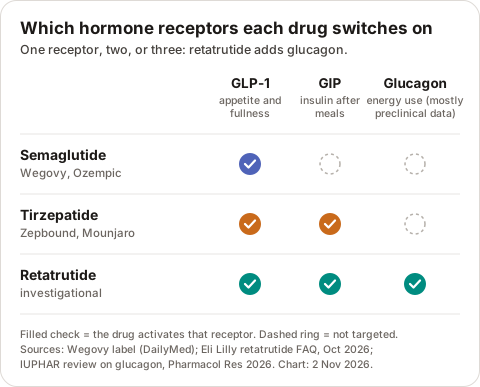
- GLP-1. Semaglutide's only target. Its label says "GLP-1 is a physiological regulator of appetite and caloric intake" (Wegovy label, DailyMed).
- GIP. A second gut hormone that boosts insulin after meals. Tirzepatide adds it to GLP-1.
- Glucagon. The new piece. The idea is that it raises how much energy the body burns, but a 2026 review is candid about the evidence: "We rely on largely pre-clinical evidence for action because clinical data is extremely limited for GCGR agonism" (IUPHAR review, Pharmacol Res 2026).
Online you will see retatrutide called "GLP-3". That is a nickname that counts receptors, not a real drug class.
Side effects and dropouts compared
Retatrutide's side effects look like the rest of the class, mostly stomach and gut, plus one that stands out: dysesthesia, which AJMC describes as "an abnormal or unpleasant skin sensation" (AJMC).
| TRANSCEND-T2D-2, 80 weeks | Retatrutide, highest dose | Retatrutide, lower dose | Semaglutide (Ozempic) |
|---|---|---|---|
| Diarrhea | 32.7% | 28.3% | 26.4% |
| Nausea | 23.8% | 21.2% | 21.3% |
| Vomiting | 15.0% | 10.2% | 13.2% |
| Constipation | 13.1% | 14.2% | 19.8% |
| Dysesthesia (abnormal skin sensation) | 6.5% | 4.8% | 2.7% |
| Stopped because of side effects | 7.9% | 4.8% | 2.7% |
Source: AJMC and HCPLive, both reporting Lilly's 28 Oct 2026 release. Lilly says most events were mild to moderate.
The plain reading: gut side effects were close between the two drugs, constipation was actually less common on retatrutide, but people on the highest retatrutide dose were nearly three times as likely to quit because of side effects (7.9% vs 2.7%). In the obesity trial TRIUMPH-1, quitting for side effects reached 11.3% on the highest dose against 4.9% on placebo (AJMC, 21 May 2026). More weight loss came with more people stopping. Any final list of risks will come from an FDA label, which does not exist yet.
When can you get real retatrutide?
Not yet, and not legally outside a trial. Lilly's own FAQ: "Retatrutide is an investigational medicine that is not on the market" (Lilly FAQ, Oct 2026).
The timeline rests on two published facts. Lilly says it is finishing its manufacturing data package and "plans to subsequently submit retatrutide in Q1 2027 for U.S. approval" (Lilly, 23 Jul 2026). And FDA says that once an application is accepted as complete, "If it is complete, the review team has 6 to 10 months to make a decision on whether to approve the drug" (FDA, drug review). Put together, the earliest realistic decision is the second half of 2027. That is our arithmetic; neither Lilly nor FDA has published an approval date, and no price exists. On cost, Lilly says only that it will be "priced to reflect the overall value to the healthcare system" (Lilly FAQ).
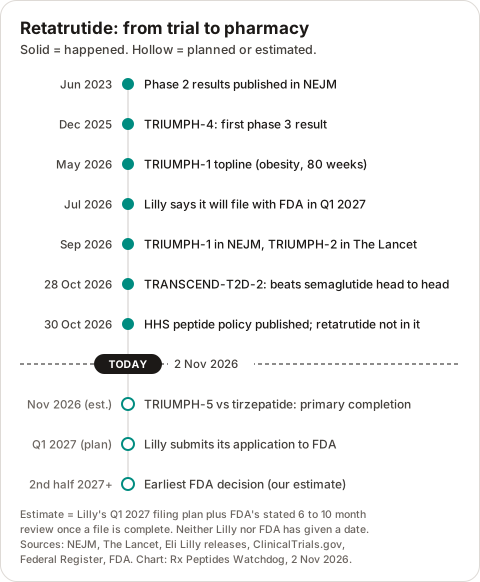
Before approval there are two legal routes, and both run through a doctor. One is a Lilly clinical trial; most TRIUMPH trials have finished enrolling, and ClinicalTrials.gov lists any that are open. The other is Lilly's single-patient expanded access program, which a treating physician requests and which is limited to people with severe obesity and serious complications (Lilly Medical).
Why not buy research retatrutide online?
Because what is in the vial is not what was in the trial, and selling it for people is illegal. Lilly's standard line: "Retatrutide is an investigational molecule that cannot be legally sold or marketed for human use" (Lilly, 23 Jul 2026).
FDA is just as direct. Its GLP-1 safety page says "Retatrutide and cagrilintide cannot be used in compounding under federal law" (FDA), so no licensed pharmacy may make it and any telehealth offer of compounded retatrutide is offering something FDA says cannot exist. On the research-label sellers, FDA writes that "These products have been sold directly to consumers for human use with dosing instructions" and "The agency urges consumers not to purchase these products which are of unknown quality and may be harmful to their health" (FDA).
What can be inside, in Lilly's words: "Illicit retatrutide products may contain unknown ingredients, harmful contaminants and impurities" (Lilly FAQ). Every trial number on this page came from Lilly's manufactured drug, given under medical supervision. None of them transfer to a vial from a website.
The HHS peptide policy does not change this. The 28 October 2026 interim policy lets 503A pharmacies compound six peptides under ten conditions: BPC-157, TB-500, MOTS-c, Semax, Epitalon and KPV (Federal Register). Retatrutide is not on that list. Our HHS peptide policy explainer covers the details, and the peptide legal status tracker lists retatrutide as investigational and not compoundable.
The harm is not hypothetical. Two news reports show what happens:
How to spot the sellers, and why this site lists prescription programs only, is in our research vs prescription peptides guide. The scam checker runs any peptide website through the same questions.
What to do today
If you want the strongest weight-loss medicine you can legally get right now, retatrutide is not on the menu. The drugs that are:
| Option | What it is | FDA status | Where to compare prices |
|---|---|---|---|
| Tirzepatide (Zepbound, Mounjaro) | GLP-1 + GIP, Lilly | Approved; compounded versions are not FDA-approved | PriceTracker GLP-1: cheapest tirzepatide |
| Semaglutide (Wegovy, Ozempic) | GLP-1, Novo Nordisk | Approved; compounded versions are not FDA-approved | PriceTracker GLP-1: cheapest semaglutide |
| Retatrutide | GLP-1 + GIP + glucagon, Lilly | Investigational; trial or expanded access only | ClinicalTrials.gov |
Tirzepatide is the closest relative: it shares two of retatrutide's three targets and beat semaglutide head to head in SURMOUNT-5 (NEJM 2025). Whether any of these fits you is a decision to make with a licensed clinician. Our sister site PriceTracker GLP-1 tracks live GLP-1 program prices and keeps a library of retatrutide videos from clinicians and news outlets.
If you came here for the other peptides in the news, the ones HHS's policy now covers, our price table lists every prescription program's lowest all-in monthly price with its source, and the ranked list scores them on safety and price.
FAQ
Is retatrutide better than semaglutide?
In the one head-to-head trial so far, yes on weight and blood sugar. In TRANSCEND-T2D-2, adults with type 2 diabetes on the highest retatrutide dose lost 20.9% of body weight at 80 weeks versus 9.4% on Ozempic, and A1C fell 2.2 points versus 1.8. More people quit retatrutide for side effects (7.9% versus 2.7%), the results are topline, and retatrutide is not approved.
Did retatrutide beat semaglutide by over 50%?
More than that, in the head-to-head trial: 20.9% versus 9.4% weight loss is 2.2 times as much, or 122% more in relative terms and 11.5 percentage points in absolute terms. Across separate obesity trials, TRIUMPH-1's 25.0% against STEP 1's 14.9% is 68% more, but those trials ran at different times in different people.
Is retatrutide FDA approved?
No. Lilly says retatrutide is an investigational medicine that is not on the market. The company plans to submit it to FDA in the first quarter of 2027, and FDA's stated review window for a complete application is 6 to 10 months, which puts the earliest likely decision in the second half of 2027.
Is research peptide retatrutide the same as Lilly's drug?
Nobody can know. FDA calls research-labelled GLP-1 products of unknown quality and possibly harmful, and Lilly says illicit retatrutide may contain unknown ingredients, contaminants and the wrong amount of drug. The trial results came from Lilly's manufactured product under medical supervision, so they say nothing about a vial bought online.
Does the HHS peptide policy make retatrutide legal to compound?
No. The October 2026 HHS interim policy covers six peptides only: BPC-157, TB-500, MOTS-c, Semax, Epitalon and KPV. Retatrutide is not one of them, and FDA states that retatrutide cannot be used in compounding under federal law. A program offering compounded retatrutide is offering an unapproved drug.
What are the main side effects of retatrutide compared with semaglutide?
Gut effects such as diarrhea and nausea were similar between the two in the head-to-head trial, and constipation was less common on retatrutide. Dysesthesia, an abnormal skin sensation, was more common (6.5% on the highest dose versus 2.7%), and so was stopping treatment because of side effects (7.9% versus 2.7%).
Has retatrutide been compared with tirzepatide?
Not yet in a reported trial. TRIUMPH-5 compares retatrutide with tirzepatide in adults with obesity, and ClinicalTrials.gov lists its estimated primary completion as November 2026. Until it reports, any retatrutide versus tirzepatide comparison is across separate trials.
Sources
All read on 2 November 2026 unless noted.
- Eli Lilly, TRANSCEND-T2D-2 topline release, 28 Oct 2026: investor.lilly.com, as reported by AJMC, HCPLive and BioPharm International
- Jastreboff et al., TRIUMPH-1, N Engl J Med, 29 Sep 2026: PubMed 42814954
- Jastreboff et al., retatrutide phase 2, N Engl J Med 2023: PubMed 37366315
- Wilding et al., STEP 1, N Engl J Med 2021: PubMed 33567185
- Jastreboff et al., SURMOUNT-1, N Engl J Med 2022: PubMed 35658024
- Aronne et al., SURMOUNT-5, N Engl J Med 2025: PubMed 40353578
- AJMC, TRIUMPH-1 topline, 21 May 2026: ajmc.com
- Eli Lilly, TRIUMPH-2 and TRIUMPH-3 topline and filing plan, 23 Jul 2026: PR Newswire
- Eli Lilly, What to know about retatrutide, updated Oct 2026: lilly.com
- Lilly Medical, expanded access program for retatrutide: medical.lilly.com
- FDA, concerns with unapproved GLP-1 drugs used for weight loss: fda.gov
- FDA, the drug development process, step 4, FDA drug review: fda.gov
- HHS interim peptide policy, Federal Register 2026-22192, 30 Oct 2026: federalregister.gov
- ClinicalTrials.gov, TRIUMPH-5 (NCT06662383): clinicaltrials.gov
- Wegovy prescribing information: DailyMed
- Elmendorf et al., IUPHAR review on glucagon, Pharmacol Res 2026: PubMed 41478576
Compare prescription peptide programs on price and safety in our price table.